2 Tips: Perfect Guide to Pentyl vs Isopropyl Cleaners
Choosing between two alkyl nitrite formulations is rarely a matter of preference alone. For buyers who care about purity, shelf behavior, and packaging integrity, the real question is how pentyl and isopropyl differ at the specification level – and how those differences show up in container design, evaporation control, and handling protocol.
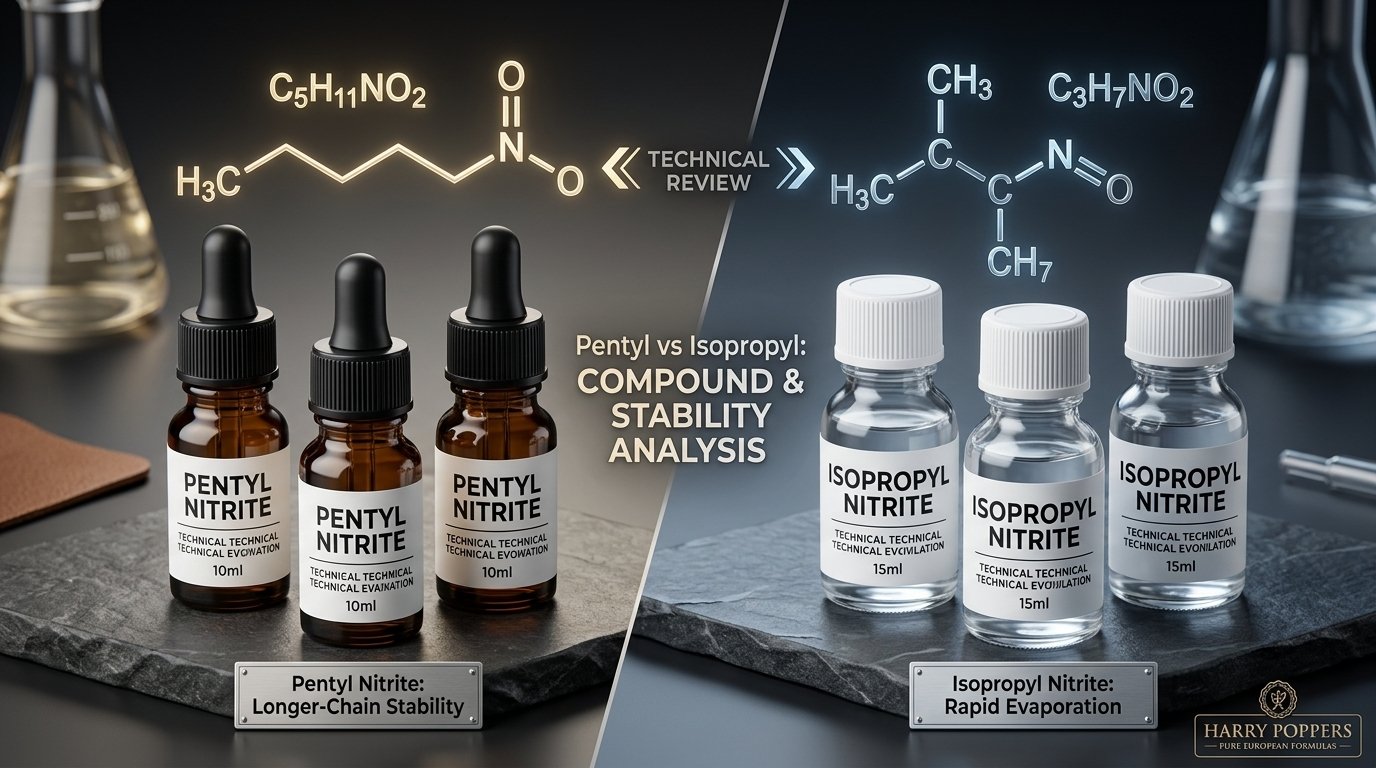
This technical review compares Pentyl vs Isopropyl across compound identity, physical formatting, bottle and cap attributes, stability, storage, and safe industrial handling, using objective criteria only.
Harry Poppers stocks European-manufactured aromas where the formula designation is printed clearly on the label, so the comparison below reflects the labeling and packaging conventions used across the range at
Harry Poppers Store.
Pentyl Nitrite: Compound Identity and Formatting
Pentyl nitrite (also written as isoamyl/iso-pentyl in some supplier documentation) is the longer-chain alkyl nitrite family. It is conventionally supplied as a clear to pale-yellow liquid with a distinctly sweet, fruity aroma profile.
At the technical level, the compound is identified by its CAS registration, batch code, and the purity percentage declared on the certificate of analysis that accompanies the shipment.
From a formatting standpoint, pentyl formulations are commonly packaged in 10 ml, 15 ml, 24 ml, and 30 ml fills.
Larger fills are the norm because pentyl has a comparatively slower headspace build-up than shorter-chain nitrites, which is one of the reasons premium European pentyl SKUs favor 24 ml and 30 ml glass bottles.
-
- Compound Class: Alkyl Nitrite (pentyl / iso-pentyl family)
- Typical Appearance: Clear to pale-yellow liquid
- Common Fill Sizes: 10 ml, 15 ml, 24 ml, 30 ml
- Typical Packaging: Amber or brown glass, sometimes aluminum
- Aroma Descriptor: Sweet, fruity, rounded
Isopropyl Nitrite: Compound Identity and Formatting
Isopropyl nitrite is the shorter-chain member of the comparison. In technical documentation it appears with its own CAS number and a declared assay percentage, and it is supplied as a clear liquid with a sharper, more solvent-like aroma profile than pentyl.
Because the molecule is smaller and more volatile, isopropyl evaporates from an open container more quickly, which directly shapes how it is bottled and capped.
Isopropyl formulations are frequently filled at 10 ml and 15 ml – the “medium” and “small” formats – precisely because a shorter working life in the bottle favors smaller, faster-turnover units. European isopropyl SKUs are usually stabilized during production, and the label typically notes the stabilization step alongside the CAS data.
-
- Compound Class: Alkyl Nitrite (isopropyl family)
- Typical Appearance: Clear liquid
- Common Fill Sizes: 10 ml, 15 ml
- Typical Packaging: Glass with an evaporation-resistant cap
- Aroma Descriptor: Sharp, clean, solvent-forward
Pentyl vs Isopropyl: Side-by-Side Technical Specification
The parameters below summarize the Pentyl vs Isopropyl comparison on the attributes that matter for sourcing and storage. Values reflect common industry formatting conventions; always confirm the exact declared specification on the individual product label.
-
- Chain Length: Pentyl = longer chain; Isopropyl = shorter chain
- Volatility Profile: Pentyl = lower volatility; Isopropyl = higher volatility
- Typical Fill Range: Pentyl = 15-30 ml; Isopropyl = 10-15 ml
- Preferred Bottle: Pentyl = amber glass/aluminum; Isopropyl = glass with sealed cap
- Shelf Stability: Pentyl = longer headspace life; Isopropyl = shorter headspace life
- Labeling Emphasis: Both = CAS number, batch code, fill volume, safety cap
When buyers compare Pentyl vs Isopropyl purely on paper, the differentiator is not quality but evaporation rate and, by extension, packaging design. A slower-evaporating pentyl formula tolerates a larger bottle and a wider opening; a volatile isopropyl formula benefits from a tighter seal and a smaller format.
Physical Formatting and Presentation Differences
Physical formatting covers the bottle silhouette, body material, neck geometry, and the way the closure seats against the neck. Pentyl SKUs tend to use wider-bodied glass with a broad shoulder, while isopropyl SKUs more often appear in slimmer, taller bottles.
The neck diameter is deliberate: wider necks are paired with formulations that need controlled diffusion, and narrower necks with formulations where rapid headspace accumulation must be limited.
Label construction also differs in practice. Premium pentyl and isopropyl products use gloss or matte laminated labels with the brand name rendered in large type, the compound name and fill volume in the lower third, and the safety cap instruction printed near the closure. Holographic and foil finishes are reserved for the higher-tier SKUs.
Container Attributes: Bottles, Caps, and Seals
Container attributes are where a Pentyl vs Isopropyl evaluation becomes a practical decision rather than a theoretical one.
-
- Body Material: Amber/brown glass is the default because it limits light transmission, which degrades both compound families. Aluminum bottles are used for select 30 ml pentyl fills where impact resistance is prioritized.
- Wall Thickness: Thicker walls reduce thermal fluctuation inside the bottle, which matters more for volatile isopropyl fills.
- Cap Type: A screw cap with an internal liner and a tamper-evident safety seal is standard. Secondary “secure” or “child-resistant” caps are common on premium SKUs.
- Liner Material: A chemically inert liner prevents the closure from absorbing the formulation and slowing the seal over repeated openings.
- Opening Diameter: Wider openings support controlled diffusion; narrower openings slow loss from the headspace.
- Batch and Seal Marking: Factory stamp, batch code, and a secure cap seal are the three container attributes buyers should verify first.
Across the range at your local supplier, container attributes are listed alongside each product so the fill volume, bottle material, and cap type can be checked before purchase.
Stability Profile and Shelf-Life Behavior
Stability is best understood as resistance to change over time. Three variables drive it: temperature, light exposure, and headspace volume.
Pentyl wins on stability in most comparisons because its lower volatility means less material migrates into the headspace per unit of time.
That translates into a longer usable life in the bottle and a more predictable opening-count.
Isopropyl, being more volatile, loses headspace concentration faster and therefore shows a shorter stability curve – which is exactly why isopropyl is packaged in smaller fills and stabilized during production.
The Pentyl vs Isopropyl stability comparison can be summarized in three practical points:
-
- Headspace Loss: Isopropyl loses concentration faster than pentyl configurations.
- Opening Sensitivity: Every open-and-close cycle accelerates loss for both, but more for isopropyl formulations.
- Turnover Pacing: Isopropyl favors a faster consumption cycle; pentyl tolerates longer storage between uses.
A ceramic power pack pellet – a small inert moisture-binding insert present in some SKUs – is one common design answer to headspace loss, and it extends usable freshness in both pentyl and isopropyl bottles. To ensure complete compliance with chemical safety profiles, you can review the international handling regulations via
Wikipedia’s Alkyl Nitrites Documentation.
Technical Handling and Safety Reminders
-
- Adults Only: These volatile compound products are strictly for adult handling and must be kept completely out of reach of minors.
- Industrial Cleaners: These items are manufactured and sold strictly as room odorizers, solvent cleaners, and leather cleaners. They are not intended for human consumption or direct inhalation under any circumstances.
- Storage Guidelines: Always store your liquid containers perfectly upright, with safety caps sealed tightly, in a cool, dark environment away from ambient heat or open flames.
#DoubleScorpio #PremiumAroma #LeatherCleanerPH #RoomOdorizer #AromaCleaners