
Fast & Discreet Shipping Nationwide • Secure Checkout • Authentic Products
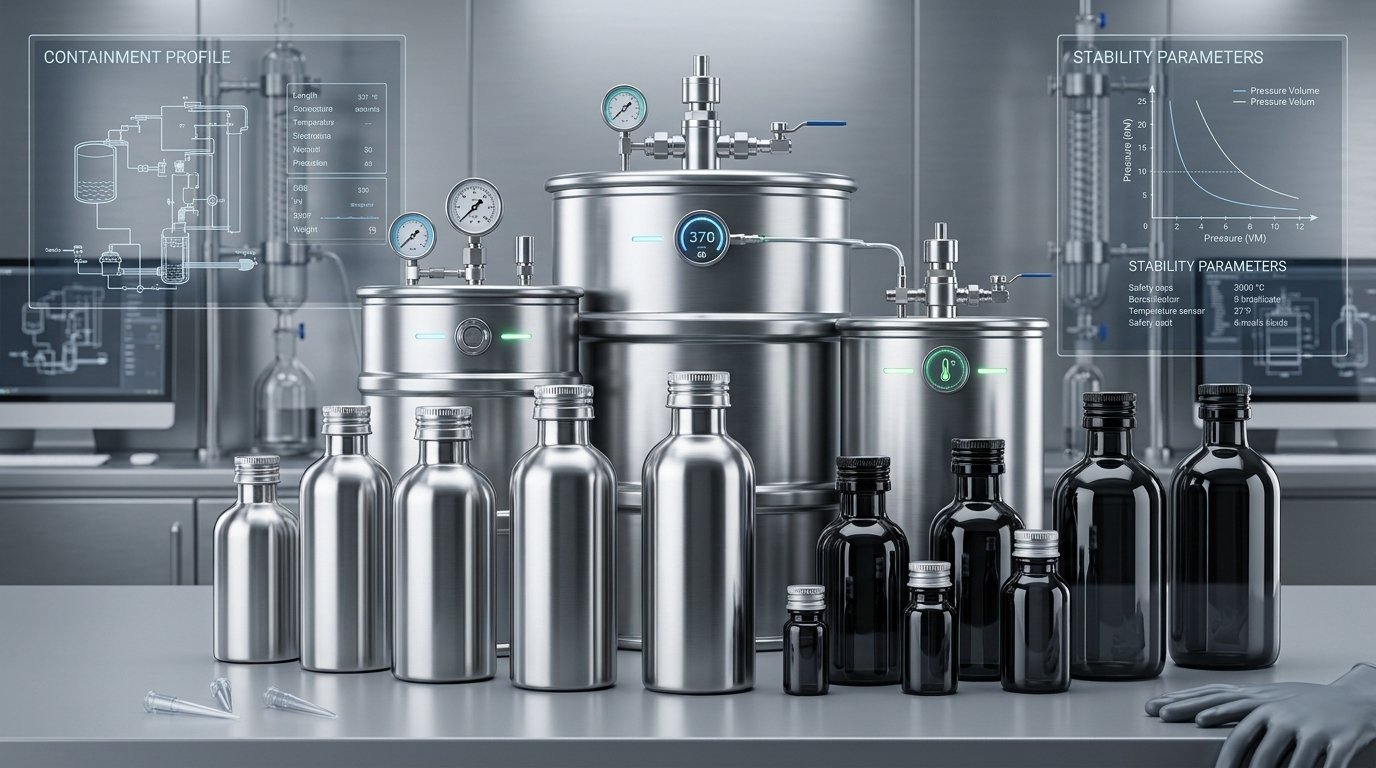
Advanced Container Engineering is the discipline that decides whether a premium aroma product arrives at the shelf in factory-fresh condition or arrives degraded, discolored, and compromised. At harrypoppers.net, container design is treated as a first-class engineering problem, not an afterthought. This guide breaks down the objective side of the craft: materials, tolerances, physical formatting, closure mechanics, and the safe industrial handling guidelines that keep specialty aroma and leather-care formulations stable from production line to end user.
[IMAGE ALT TEXT PLACEHOLDER: Row of opaque glass and brushed-aluminum specialty aroma bottles on a dark matte surface, one bottle seated inside a polished stainless steel protective sleeve, dramatic side lighting.]
Advanced Container Engineering is the systems-level design of a liquid package across four interdependent layers: the primary vessel, the protective sleeve or protector, the closure and seal, and the outer formatting or label system. Each layer has its own specification envelope, and each must hold without forcing the others out of tolerance. A bottle that resists light but cannot hold a seal is not engineered. A stainless steel protector that looks impressive but traps heat is not engineered either. Advanced Container Engineering exists to make all four layers work together so the formulation inside remains chemically and physically stable.
Primary vessels in premium aroma and leather-care packaging typically fall into three material families, each with a distinct specification profile.
Glass (amber, cobalt, and flint). Glass remains the reference material for chemical inertness. Borosilicate and soda-lime glass both resist reaction with most volatile organic contents, and glass offers zero permeability to vapor. The trade-off is mechanical fragility. In Advanced Container Engineering, glass primary vessels are specified with wall-thickness minimums and are almost always paired with a secondary protector when the product must survive transit.
Aluminum. Aluminum primary bottles are lightweight, non-permeable, and unbreakable under normal handling. Because aluminum is fully opaque, it eliminates the light-transmission variable entirely. Aluminum is also thermally conductive, which makes the choice of protector and storage environment critical – Advanced Container Engineering accounts for this by specifying insulated or sleeved formats wherever ambient heat is a risk.
Opaque-coated glass. Many premium formats use glass blocked by an opaque coating or an opaque label wrap. This is a hybrid specification: it keeps the inertness of glass while reducing light exposure. The coating must be checked for adhesion stability, since a peeling coating reopens the light pathway.
[IMAGE ALT TEXT PLACEHOLDER: Close-up macro of a brushed aluminum bottle cap and neck threads showing clean threading and a tight seal gap under cold studio light.]
Stainless steel protectors are secondary containment components that wrap the primary vessel. Their purpose is purely mechanical, optical, and thermal. In Advanced Container Engineering, a protector is specified to deliver several properties at once.
First, light exclusion. Stainless steel is fully opaque, so a closed protector barrel removes the ultraviolet and visible-light exposure that degrades many volatile formulations. Second, impact resistance. A stainless steel shell absorbs drop and crush energy that would otherwise reach a glass primary vessel. Third, dimensional rigidity. Because stainless steel holds its form under load, the protector maintains a consistent internal air gap around the bottle, which keeps the primary vessel centered and prevents point-contact stress.
Grade matters. Advanced Container Engineering specifications for protectors usually call for 304 or 316 stainless steel – alloys chosen for corrosion resistance against ambient humidity and incidental residue. Surface finish is specified as brushed, mirror-polished, or bead-blasted. Brushed finishes hide handling marks; mirror finishes maximize reflectivity and cleaning ease; bead-blasted finishes offer the highest grip friction.
Fit tolerance is the single most important protector spec. A protector must be sized so the primary vessel slides in with controlled clearance – tight enough to prevent rattle, loose enough that a swollen or slightly out-of-spec bottle never wedges. Advanced Container Engineering builds this clearance into the drawing before production, not after.
[IMAGE ALT TEXT PLACEHOLDER: Cutaway or exploded diagram-style view showing a glass bottle seated inside a stainless steel protector barrel with visible clearance gap and foam insert ring.]
Physical formatting is how the engineered package presents itself: volume, profile, footprint, and ergonomics. Advanced Container Engineering standardizes formatting so that a 10ml, 24ml, 25ml, or 30ml product reads as part of one coherent family.
Volume and fill. Stated fill volume is calibrated to leave a defined headspace above the liquid. Headspace is not empty space – it is a controlled vapor buffer that gives the contents room for thermal expansion without pressurizing the seal. Underfilling reduces usable volume; overfilling forces vapor past the closure under warm conditions.
Profile and footprint. Cylindrical profiles dominate because they distribute internal pressure evenly and are easiest to sleeve. Square and rectangular formats appear where shelf density and grip ergonomics matter more than pressure distribution. Advanced Container Engineering selects a profile against the storage and transit environment the product will actually face.
Ergonomics and grip. Protector diameter, cap knurling, and body taper are specified so a user can open and reseal the product with a single hand. This is a safety-relevant formatting decision as much as a comfort one: an awkward package invites spills.
[IMAGE ALT TEXT PLACEHOLDER: Overhead flat-lay of specialty aroma bottles in 10ml, 24ml, and 30ml formats lined up to show consistent family styling and footprint.]
The closure is where Advanced Container Engineering succeeds or fails most visibly. A formulation can survive light, heat, and impact, then lose its integrity through a single weak seal.
Thread geometry. Cap threads are specified with a defined pitch and start count so that closure occurs in a predictable number of turns. Consistent thread geometry is what makes a cap feel tight at the same point on every unit.
Seal liner material. Liners are selected for chemical compatibility with the contents. Common specifications include PTFE-faced liners and inert polymer liners – chosen because they resist attack by volatile contents and do not leach into the formulation. Advanced Container Engineering matches liner material to the specific contents class rather than using a generic default.
Tamper evidence and secondary seals. Induction seals and shrink bands provide a verifiable seal state at first opening. They also function as a transit seal, holding the closure against vibration during shipping.
[IMAGE ALT TEXT PLACEHOLDER: Exploded view of a bottle neck showing cap, seal liner, and induction seal ring separated above the threads.]
Advanced Container Engineering can be summarized as the control of three environmental variables.
Light. Ultraviolet and visible light drive photodegradation in volatile formulations. The engineering answer is opacity – opaque aluminum, opaque-coated glass, or a stainless steel protector barrel.
Heat. Temperature accelerates every degradation pathway. Advanced Container Engineering responds with material selection and geometry: aluminum’s conductivity is offset by protectors and insulated packaging, and headspace is sized so warm conditions expand vapor rather than force it through the seal.
Vapor migration. Any closure is a potential vapor pathway. The engineering answer is a compatible seal liner plus a tight, consistently threaded cap, verified by leak testing before a format is approved for production.
These handling rules apply to production, warehouse, and retail environments where specialty aroma and leather-care products are stored and moved.
[IMAGE ALT TEXT PLACEHOLDER: Warehouse shelving with specialty aroma cartons stored upright and cap-up, organized in secondary containment trays under neutral lighting.]
Advanced Container Engineering, reduced to a checklist: primary vessel in inert glass or non-permeable aluminum; opaque or coated for light exclusion; protector in 304/316 stainless steel with specified clearance; cap with defined thread pitch and an inert seal liner; headspace sized for thermal expansion; tamper evidence at the closure; and formatting standardized across volumes so the family reads as one engineered system.
For specialty aroma, room odorizer, and leather-cleaner formats, container integrity is the whole value proposition. A premium product is judged in the first seconds – clarity of liquid, sharpness of label, tightness of cap. Advanced Container Engineering protects each of those signals. When a stainless steel protector does its job, the primary vessel arrives unstressed, unexposed to light, and sealed to spec, and the formulation inside is delivered exactly as it left the line. That is the measurable outcome of good container design, and it is why harrypoppers.net treats Advanced Container Engineering as a core standard rather than a cosmetic detail.
Vapor.
High vapor pressure leads to headspace expansion and evaporation loss. Advanced Container Engineering seals the container with chemical-resistant liners and heavy threads that block any vapor pathways. To further inspect the international structural parameters and handling criteria associated with volatile chemical groups, you may view the official breakdowns compiled within Wikipedia’s Alkyl Nitrites Documentation.
#DoubleScorpio #PremiumAroma #LeatherCleanerPH #RoomOdorizer #AromaCleaners