
Fast & Discreet Shipping Nationwide • Secure Checkout • Authentic Products
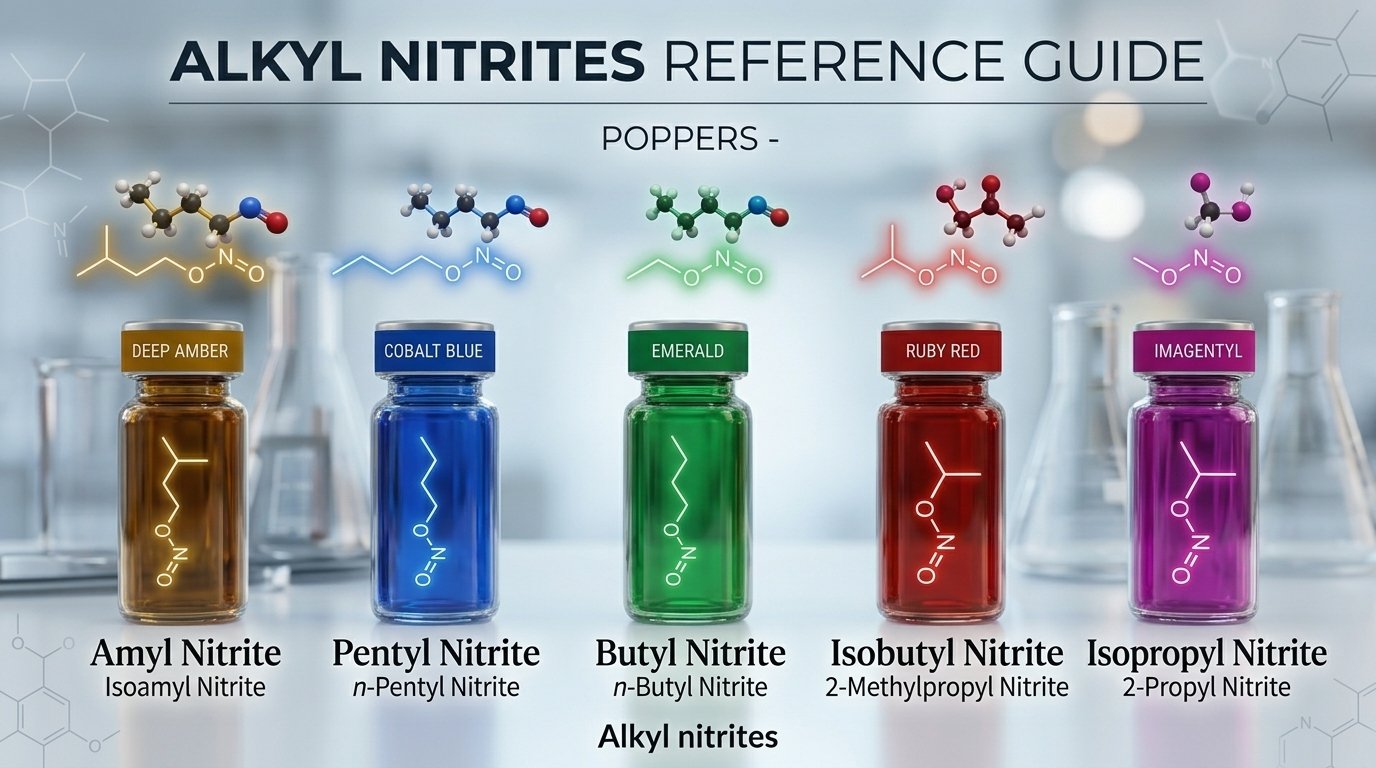
If you have ever stood in front of a poppers shelf and wondered why every bottle seems to carry a slightly different chemical name, you are not alone. Products are often labelled as solvent cleaners or room odorisers, but the active formula named on the bottle is usually one of three alkyl nitrites: amyl (pentyl) nitrite, isopentyl nitrite, or isobutyl nitrite. They sound almost identical, yet they behave differently in practice.
This guide decodes those labels so you can tell what is inside the bottle, understand how “strength” really works, and choose the formula that fits your experience level.
At their most basic, poppers products are alkyl nitrite compounds — a family of liquid chemicals made to meet solvent, leather-cleaner, and room-odour applications. Because they are legally sold and marketed for those uses, the chemistry is what matters more than the branding on the front of the bottle.
The name on the label tells you which alkyl group the nitrite is built on. That alkyl group is the single biggest driver of the product’s character: how quickly a rush arrives, how intense it feels, and how long it lasts. Everything else — bottle size, marketing claims, accent colours — is secondary to that one detail.
Amyl nitrite is the classic formula and the one most people picture when they think of this category. Technically, “amyl” and “pentyl” refer to the same five-carbon structure, so you will often see the two words used interchangeably on labels.
Products based on amyl nitrite are known for a smooth but substantial effect. The onset is quick and the physical sensation tends to be warm and full-bodied — which is why amyl is the default reference point for “a proper poppers rush.” For many experienced buyers, it is the benchmark other formulas are compared against.
Isopentyl nitrite is a close structural relative of amyl nitrite — the same five-carbon count, just arranged differently. Many buyers describe it as a slightly cleaner, more refined take on the amyl experience, with a fast onset and a clear, even feeling rather than a blunt spike.
Products built on isopentyl nitrite are frequently described as “super strong” or “rush” variants. It is a popular middle ground: potent enough to be interesting, yet controlled enough to be usable across a wide range of situations.
Isobutyl nitrite is the other major branch of the family. It has a shorter carbon backbone, which changes how quickly the product acts and how sharp it feels. Where amyl is warm and smooth, isobutyl tends to be described as harder-hitting, with a more immediate and more aggressive intensity.
This makes isobutyl-based products a staple of the “extreme” and “ultra strong” tier. Because the effect lands fast and hard, these are generally recommended for buyers with more experience, not as a first purchase.
The single most important thing to understand is that the label’s word “strong” refers to the formula, not to a single ingredient that scales up forever. There is no slider that makes a product twice as strong — what you are comparing is the character of one alkyl nitrite against another.
As a rough guide:
Which one is right for you depends on what you are looking for. A first-time buyer usually has a better experience starting with a smooth amyl product than jumping straight to an aggressive isobutyl one. Experienced buyers who want maximum intensity will often reach for the isobutyl or high-strength isopentyl lines.
Here is the part most people miss: two bottles can carry the same chemical name and be completely different in quality. The purity of the formula, how it was produced, and how it was handled all affect the final result far more than the printed name.
That is why authenticity checks matter. A formula that is past its freshness, cut with fillers, or produced without proper care will underperform no matter what it claims on the label. Established producers and trustworthy retailers who certify their stock — including European laboratories that meet pharmaceutical-grade standards and full-batch traceability — exist precisely to protect against counterfeits and inconsistent batches.
When you buy, look for sellers who are transparent about their sourcing rather than chasing the loudest label. A trusted retailer is the difference between a predictable, quality bottle and an uncertain one.
Regardless of which formula you choose, sensible handling is non-negotiable. These compounds are volatile by design, so respect the basics:
This is also why avoiding counterfeits matters beyond quality alone. Fake products are produced with no quality control, no safety oversight, and no idea of what is actually inside. Sticking with verified, authentic stock is the only way to be sure of what you are inhaling.
The three names on a poppers bottle are not marketing fluff — they are real chemistry that changes the experience. Amyl is the warm, classic baseline. Isopentyl is the clean, fast middle ground. Isobutyl is the hard-hitting extreme tier.
Match the formula to your experience level, insist on verified authentic stock, and follow basic safety handling, and you will get the experience the label promises. If you are ever unsure which formula fits you, reach out to a retailer that will give you a straight, knowledgeable answer — a good one will always point you to quality and safety, not just the strongest-sounding name on the shelf.